
services
Steroid Injections
A steroid injection (more precisely, a corticosteroid injection) reduces inflammation at its source rather than simply numbing pain. For the right conditions, such as Morton’s neuroma, plantar heel pain, joint synovitis, or an irritated tendon sheath, it can settle symptoms significantly within days to weeks. It isn’t the right answer for every kind of foot pain, and part of our job is helping you understand whether it’s the right answer for yours before you go ahead.
Steroid injections help by:
- Reducing inflammatory chemistry and calming irritated neural tissue, thereby decreasing pain and improving function.
- They are most useful when inflammation is a significant driver, less so when structural degeneration is dominant.
How Steroid Injections Work
Corticosteroids are anti-inflammatory and immunomodulatory medicines, not painkillers in the traditional sense. Rather than blocking pain signals, they act on the underlying inflammatory chemistry that’s driving the pain:
tory effect.
- They inhibit the enzyme phospholipase A2 and reduce production of prostaglandins and leukotrienes, which are chemical messengers that drive swelling and irritation
- They suppress inflammatory cytokines and reduce vascular permeability, calming the tissue reaction around a joint, nerve, or tendon sheath
- By reducing chemical irritation around nearby nerve endings, they can lower the degree of nerve sensitisation that keeps pain signalling turned up
This is particularly relevant in conditions where inflamed tissue is irritating a nerve directly, such as Morton’s neuroma, or where a joint capsule or tendon sheath has become inflamed, such as capsulitis or synovitis. As pain settles, muscle guarding tends to ease and walking pattern often normalises, which is why people frequently notice improved function as well as less pain.
What's Actually in the Injection
We use methylprednisolone acetate, a corticosteroid, usually combined with a local anaesthetic. The anaesthetic serves two purposes: it gives you some immediate, short-lived pain relief so we can confirm we’ve treated the right structure, and it increases the volume of fluid injected, which helps it disperse more evenly through the tissue. The steroid itself takes longer to act but provides the lasting anti-inflammatory effect.
How Quickly Does It Work, and How Long Does Relief Last?
- Local anaesthetic → minutes to hours
- The corticosteroid's anti-inflammatory effect typically begins over two to seven days
- Peak benefit is often seen within four to six weeks
Relief can last anywhere from several weeks to several months, and this varies a great deal from person to person and condition to condition. We won’t promise a specific duration, because being honest about that variability is more useful to you than a number we can’t guarantee.
Where Steroid Injections Work Less Well
Some chronic foot conditions, plantar fasciopathy and tendinopathy in particular, are often driven more by degenerative tissue changes than by active inflammation. In these cases, a steroid injection can still reduce pain, but it doesn’t repair the underlying tissue and may not change the long-term course of the condition. This is a large part of why recurrence is common in these specific conditions, and why we’ll sometimes recommend other treatments, such as shockwave therapy or exercise rehabilitation, alongside or instead of injection, depending on what we find at assessment.
What to Expect
At your assessment: We’ll examine the painful area, confirm the diagnosis (using our onsite diagnostic ultrasound where it helps pinpoint the exact structure involved), and talk through whether a steroid injection is a sensible option compared with the alternatives.
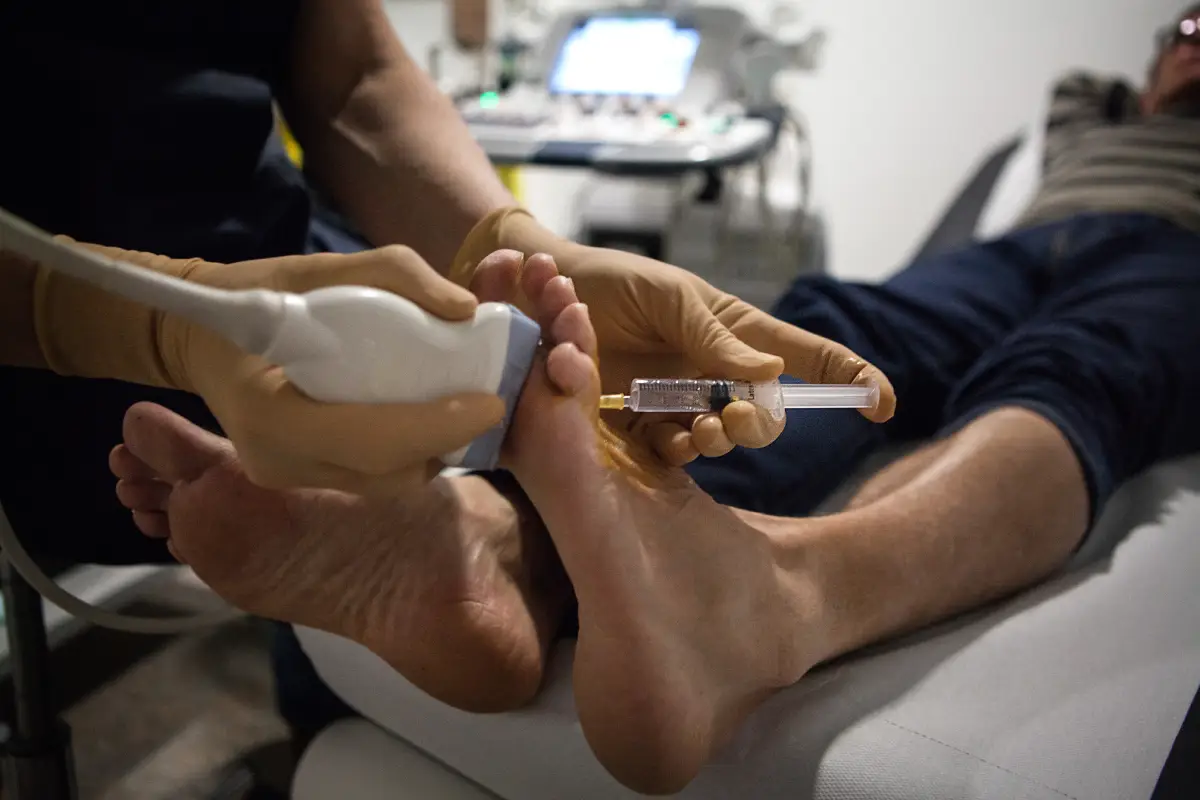
During the injection: The injection itself takes only a minute or two. Most patients describe brief stinging or pressure rather than significant pain. Depending on the area being treated, we may use ultrasound guidance to place the injection precisely.
Immediately afterwards. You can usually walk out and return to light activity the same day, though we’ll advise you to avoid strenuous exercise for 24 to 48 hours. A short-lived increase in discomfort, known as a ‘post-injection flare’, is common in the first day or two as the local anaesthetic wears off and before the steroid effect begins, and normally settles on its own.
Risks and Limitations
We believe you should have this information before you consent to any injection, not just a leaflet afterwards:
- Fat pad atrophy: thinning of the fat pad, particularly relevant to repeated injections into the plantar heel
- Skin depigmentation: a lightening of the skin near the injection site, more noticeable in darker skin tones
- Tendon weakening or rupture: rare, but documented, which is why we're selective about injecting directly into or near load-bearing tendons
- Post-injection flare: a temporary increase in pain, usually resolving within a day or two
- Infection: rare, and minimised through sterile technique
- Allergic reaction, including anaphylaxis: this is a medical emergency, and while it is genuinely rare, we take it seriously. Our clinical team is trained to recognise and manage it, and we ask about any known drug allergies before every injection
We’ll also flag that steroid injections are not usually recommended as a repeated, ongoing solution for the same site. If a condition needs more than two or three injections a year into the same area, that’s usually a sign we need to address the underlying cause rather than keep treating the symptom.
Why Choose Active Health for Steroid Injections
Injection therapy at Active Health is delivered by HCPC-registered podiatrists working under the clinical governance of Dr David Cashley (PhD, FFPM RCPS Glasgow, MRCPod, HCPC CH13665), our Clinical Director, who has practised in Dundee for over 30 years, holds an honorary research fellowship with the University of Dundee Medical School, and is podiatrist to Dundee Football Club.
Our onsite diagnostic ultrasound and computerised gait analysis mean injection decisions are backed by objective assessment, not guesswork, which matters when a treatment carries real risks and real limitations alongside its benefits.
Steroid Injection Cost
Pricing depends on the site being treated and whether ultrasound guidance is used. See our pricing page for current fees, or call reception to confirm cost for your specific condition.
FAQs
Frequently Asked Questions
Can't find the answer to your question?
Send us a message and we’ll get back to you as soon as possible!
What are steroid injections used for in podiatry?
They’re most commonly used for Morton’s neuroma, plantar heel pain, joint synovitis, and inflamed tendon sheaths (tenosynovitis or capsulitis), where inflammation is a significant driver of the pain.
Do steroid injections hurt?
Most patients feel brief stinging or pressure rather than significant pain. A local anaesthetic is usually included in the injection itself to reduce discomfort.
How quickly do steroid injections work?
The anaesthetic component can ease pain within minutes to hours, though this is temporary. The steroid’s anti-inflammatory effect usually starts within two to seven days, with peak benefit around four to six weeks.
How long does the relief from a steroid injection last?
It varies significantly by person and condition, anywhere from several weeks to several months. We can’t promise a specific duration, but we’ll be upfront about what’s realistic for your condition based on assessment.
Are steroid injections safe?
For most people, yes, when given by a trained clinician following proper technique. Like any medical treatment, there are risks, which we’ll explain in full before you consent, including rare but serious ones such as allergic reaction.
What are the risks and side effects of a corticosteroid injection?
The main risks include fat pad thinning (particularly with repeated heel injections), skin lightening near the injection site, rare tendon weakening, a short-lived flare of pain, and rare infection or allergic reaction.
What's the recovery time after nail surgery?
Not always. It reduces pain and inflammation effectively, but in conditions with a degenerative component, such as chronic tendinopathy, it doesn’t repair the tissue. We’ll often combine it with rehabilitation or other treatments for a more lasting result.
How many steroid injections can I have in the same area?
We’re generally cautious about giving more than two or three injections a year into the same site, because repeated use raises the risk of tissue thinning and suggests the underlying cause needs addressing directly.
What should I avoid after a steroid injection?
We recommend avoiding strenuous activity for 24 to 48 hours. Some increased discomfort in the first day or two is normal and usually settles without treatment.
Do I need a referral for a steroid injection in Dundee?
No referral is required. You can book an assessment directly, and we’ll confirm whether a steroid injection is appropriate before proceeding.